Paper Sizes From 4A0 to A10 and Their Uses

📐 Standards & Documentation · 2026
Get a Free Quote
Contact Us
Paper Sizes from 4A0 to A10 and Their Uses
Paper sizes from 4A0 to A10 follow a single mathematical logic set out in the ISO 216 standard, where each size is exactly half the area of the one before it. This guide walks through every size in the A series, its precise dimensions in millimetres and inches, and where each one actually gets used in practice.
You will find the full reference table, the history behind the system, and a size-by-size breakdown covering everything from giant 4A0 exhibition panels to the pocket-sized A7 notebook.
Because this system underpins architectural drawing sets, drafting standards, and construction documentation, the guide pays particular attention to how these sizes are applied on real building projects in Kenya.
Whether you are a student formatting a thesis, a drafter setting up a title block, or a project manager specifying drawing submissions, this is the reference you can bookmark and return to.
Paper sizes from 4A0 down to A10 are not an arbitrary list. They come from one formula, one ratio, and one standard that almost every country outside North America has adopted. Once you understand the logic behind the sequence, remembering every dimension in it becomes almost unnecessary, because you can work most of them out in your head.
This matters far beyond stationery. Architects choosing a sheet size for a floor plan, students formatting an academic poster, and print shops setting up a job all rely on the same underlying system. Getting it wrong wastes paper, distorts scale drawings, and can even cause a document to be rejected at submission stage. The rest of this guide breaks the system down clearly, size by size.
1 m²
Exact surface area of an A0 sheet
√2
Constant aspect ratio of every A series size
13
Standard sizes from 4A0 to A10
1975
Year ISO 216 was formally published
What Are Paper Sizes and Why Do They Follow a Standard?
A paper size is simply a fixed set of width and height dimensions that a sheet of paper is manufactured and cut to, so that printers, publishers, and offices anywhere in the world can rely on the same physical dimensions without measuring each sheet by hand. Before international standards existed, paper sizes varied by country, by mill, and sometimes even by individual print shop, which made it difficult to exchange documents, design equipment, or scale drawings consistently.
The solution most of the world settled on is ISO 216, the international standard published by the International Organization for Standardization that defines the A, B, and C series of paper sizes. Kenya, like most Commonwealth and European countries, follows ISO 216 through its adoption by the Kenya Bureau of Standards, which means the A4 sheet in a Nairobi office is identical in size to the A4 sheet used in Berlin, Tokyo, or Cape Town.
What Is the ISO 216 Standard?
ISO 216 is the international paper size standard that defines the A and B series, based on a simple geometric rule: every sheet keeps the same width to height ratio, so that when you fold or cut a sheet exactly in half along its longer side, the two resulting halves are still the same shape as the original, just smaller. This single rule generates the entire A series from 4A0 down to A10 without needing to define each size independently.
The Origin and History of the A Series Paper Size System
The mathematical foundation of the A series is older than the standard itself. The German scientist Georg Christoph Lichtenberg first described the square root of two ratio for paper in a letter written in 1786, noting that a sheet with that proportion could be halved repeatedly while keeping its shape. It took over a century for the idea to become a working industrial standard.
In 1922, the German engineer Dr. Walter Porstmann formalised the system as the German standard DIN 476, defining A0 as a sheet with an area of exactly one square metre and every subsequent size as a halving of the one before it. DIN 476 spread across Europe through the twentieth century and was eventually adopted internationally as ISO 216 in 1975, cementing the A series as the global default outside North America. ISO 216’s documented history traces this evolution from a German industrial standard to a near-universal system used in over 190 countries today.
Why Did the United States Not Adopt the A Series?
The United States and Canada continue to use Letter (215.9 by 279.4 millimetres) and Legal size paper instead of A4, largely because these formats were already deeply embedded in American manufacturing, printing, and office equipment before ISO 216 gained international traction. Switching an entire country’s printers, filing cabinets, and paper mills to a new standard proved too costly and disruptive once Letter size was already the entrenched default. This is why documents formatted for A4 sometimes print with slightly cropped margins on American printers set to Letter, and vice versa.
How the A Series Paper Sizes Are Calculated
Understanding the maths behind the A series makes the whole system intuitive rather than something to memorise. The starting point is A0, defined as a rectangle with an area of exactly one square metre and a width to height ratio of 1 to the square root of 2, approximately 1:1.414. This specific ratio is what makes the system self-repeating.
When you cut an A0 sheet exactly in half along its longer edge, you get two rectangles, each with half the area of A0. Because of the square root of two ratio, each of those halves is still proportioned exactly like A0, just smaller. That half-sized rectangle is A1. Cut A1 in half the same way and you get two A2 sheets. Continue the process and you move through A3, A4, A5, all the way down to the tiny A10. Every size in the sequence is precisely half the area of the size before it, and every size shares the identical aspect ratio.
The Simple Rule to Remember
Halving the long edge of any A series sheet always produces the next size down. Doubling the long edge always produces the next size up. A0 has 1 square metre of area, and each following size is exactly half that of the size before it, which is why A4 has roughly one sixteenth the area of A0.
What Do 4A0 and 2A0 Mean If A0 Is the Starting Point?
4A0 and 2A0 sit above A0 in size, which can be confusing since A0 is technically the reference size the whole system is built from. These oversized formats were added later to accommodate very large format printing, and they follow the same doubling logic in reverse. 2A0 is created by doubling A0’s area, and 4A0 by doubling it again, making 4A0 exactly eight times the surface area of A0. Both retain the same aspect ratio as every other A series size.
The Complete Table of Paper Sizes from 4A0 to A10
Below is the full reference table covering every standard A series size, listed with both millimetre and inch dimensions. This table is the one to bookmark for quick lookups when setting up a document template, a plotter job, or a drawing sheet.
| Size | Width × Height (mm) | Width × Height (in) | Typical Use |
|---|---|---|---|
| 4A0 | 1682 × 2378 mm | 66.2 × 93.6 in | Exhibition panels, large format plots |
| 2A0 | 1189 × 1682 mm | 46.8 × 66.2 in | Posters, presentation boards |
| A0 | 841 × 1189 mm | 33.1 × 46.8 in | Full architectural drawing sheets |
| A1 | 594 × 841 mm | 23.4 × 33.1 in | Working drawings, technical plans |
| A2 | 420 × 594 mm | 16.5 × 23.4 in | Flip charts, mid-size drawings |
| A3 | 297 × 420 mm | 11.7 × 16.5 in | Detail drawings, spreadsheets, newsletters |
| A4 | 210 × 297 mm | 8.3 × 11.7 in | Letters, reports, standard printing |
| A5 | 148 × 210 mm | 5.8 × 8.3 in | Notebooks, flyers, booklets |
| A6 | 105 × 148 mm | 4.1 × 5.8 in | Postcards, index cards |
| A7 | 74 × 105 mm | 2.9 × 4.1 in | Pocket notebooks, coupons |
| A8 | 52 × 74 mm | 2.0 × 2.9 in | Small tags, playing card size prints |
| A9 | 37 × 52 mm | 1.5 × 2.0 in | Stamps, tiny labels |
| A10 | 26 × 37 mm | 1.0 × 1.5 in | Reference sizing, novelty prints |
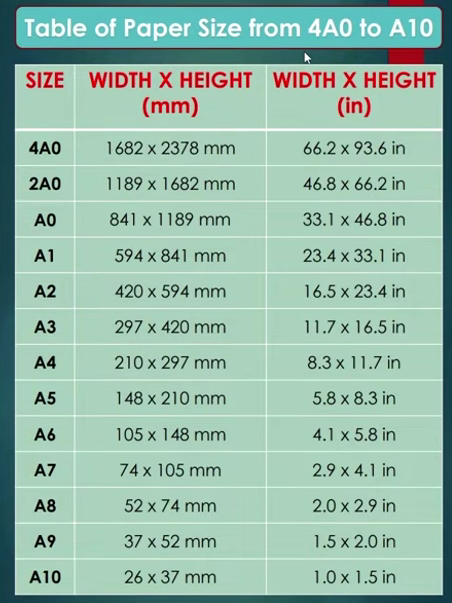
Reference table of A series paper sizes from 4A0 to A10, in millimetres and inches
With the full table in front of you, it becomes easier to see the pattern that runs through the whole guide: each row is exactly half the area of the row above it, and the width of one size becomes the height of the next size down. That relationship is what lets drafters, printers, and publishers move between sizes without recalculating proportions from scratch.
Need Drawings Prepared to the Right Sheet Size?
Structrum Limited prepares construction drawings, structural details, and site documentation formatted correctly for submission and site use across Kenya.
Get a Free Quote Contact Our TeamEvery A Series Paper Size Explained in Detail
Each size in the sequence has its own practical identity, shaped by what fits comfortably on it and what equipment can produce it. Here is what makes each one distinct.
4A0
1682 × 2378 mm
The largest standard A series sheet, with eight times the area of A0. Reserved for exhibition graphics, trade show backdrops, and oversized architectural presentation panels that need to be read from several metres away.
Extra Large Format2A0
1189 × 1682 mm
Double the area of A0. Common for academic research posters, cinema-style advertising posters, and large presentation boards used in design competitions and public exhibitions.
Large FormatA0
841 × 1189 mm
Exactly one square metre in area. The standard sheet for full architectural and engineering drawing sets, technical schematics, and large maps that need to show an entire building or site at a workable scale.
Drawing StandardA1
594 × 841 mm
Half the size of A0 and the most commonly plotted sheet size for individual architectural drawings, structural layouts, and engineering details submitted for approval.
Working DrawingsA2
420 × 594 mm
A practical middle ground, often used for flip chart pages, mid-scale technical drawings, and calendars where A1 would be unwieldy and A3 too small.
Mid FormatA3
297 × 420 mm
Twice the size of A4 and the largest size most standard office printers can handle. Common for detail drawings, spreadsheets with many columns, newsletters, and architectural sketch layouts.
Office Large FormatA4
210 × 297 mm
The default paper size for everyday printing in Kenya and most of the world. Used for letters, contracts, reports, invoices, forms, and academic assignments.
Everyday StandardA5
148 × 210 mm
Half the size of A4, commonly used for notebooks, greeting cards, flyers, and compact booklets that still need to hold a meaningful amount of text.
Compact PrintA6
105 × 148 mm
Roughly the size of a postcard. Used for postcards, small notebooks, and index cards.
Postcard SizeA7
74 × 105 mm
Close to the size of a standard playing card. Used for pocket notebooks, discount coupons, and small tickets.
Pocket SizeA8
52 × 74 mm
Small enough for luggage tags, miniature labels, and tiny reference cards where only a few words or a code need to appear.
Tag SizeA9
37 × 52 mm
Close to a large postage stamp. Rarely used on its own, appearing mainly in stationery reference tables and specialised labelling.
Micro PrintA10
26 × 37 mm
The smallest standard A series size. Almost never printed independently, existing primarily to complete the mathematical sequence and for novelty items.
Smallest Standard“Halving one sheet’s longer side always produces a smaller sheet with the identical proportions, which is the entire reason the A series can scale from a square metre down to a stamp without distortion.” Structrum Limited — Construction Documentation Standards, 2026
Paper Sizes in Architectural and Construction Drawings in Kenya
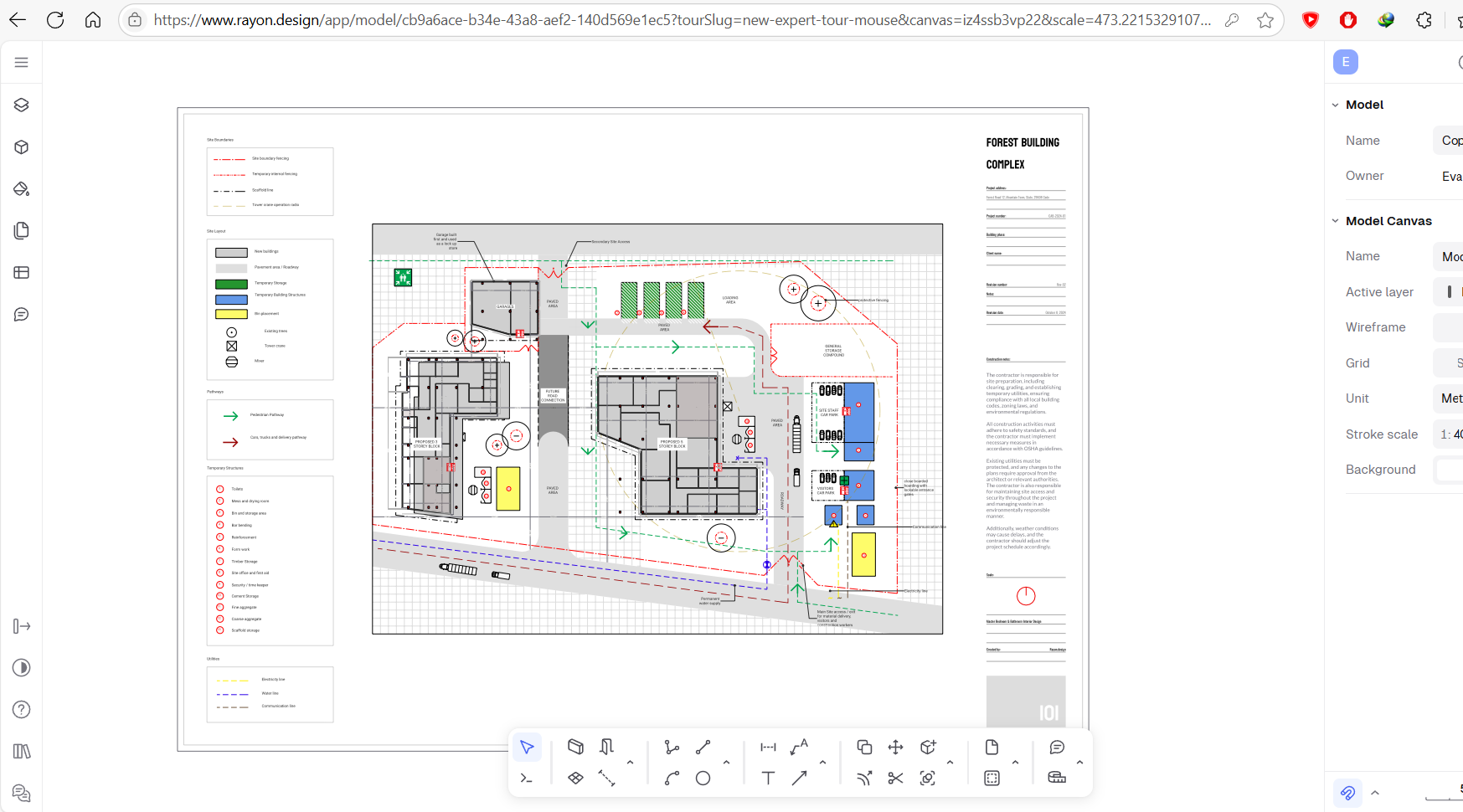
Paper size choice on a construction project is not a stylistic decision. It affects whether a drawing is legible at the scale it needs to be read, whether it fits standard drawing registers, and whether a county planning office will accept it. In Kenya, architects and structural engineers preparing drawings for submission to the National Construction Authority and county planning departments typically standardise on A1 for full working drawings and A0 for larger, more complex site or floor layouts, while A3 is common for detail sheets bound into specification documents. A4 remains the default for cover pages, reports, bills of quantities, and correspondence. The full requirements for what a submission needs to include are set out in the building plan submission requirements in Kenya.
Why Does Drawing Scale Depend on Sheet Size?
The relationship between paper size and drawing scale is direct. A building that fits comfortably on an A1 sheet at 1:100 scale would either need to be split across multiple A3 sheets, or drawn at a much smaller and less legible scale, if forced onto A3. This is why larger, more complex buildings default to A0 or A1 sheets, and why an architect’s scope of services in Kenya typically includes decisions about sheet size and layout as part of the technical drawing package, not just the design itself.
How Paper Size Choices Affect Printing and Plotting Costs
Large format sheets like A0 and A1 require a plotter rather than a standard office printer, and printing costs scale with paper area, meaning an A0 sheet costs roughly sixteen times more to print than an A4 sheet of equivalent quality. Kenyan architecture and engineering firms managing large drawing sets often balance this cost against legibility requirements, choosing A1 as a middle ground that keeps drawings readable without the expense of full A0 plots for every sheet in a set.
Paper Size and the Kenya Bureau of Standards
The Kenya Bureau of Standards adopts ISO paper size standards as part of its published standards catalogue, meaning paper manufactured and sold in Kenya follows the same A series dimensions used internationally. This alignment is what allows drawings, contracts, and reports prepared in Kenya to be shared, filed, and printed anywhere in the world without size mismatches. Full details of Kenya’s adopted standards are listed on the Kenya Bureau of Standards catalogue.
Planning a Building Project in Kenya?
Structrum Limited partners with experienced architects and structural engineers across Kenya to prepare fully compliant drawing sets, from concept sketches to construction-ready documentation.
Get a Free Quote Contact UsThe B Series and C Series: How They Relate to the A Series
ISO 216 does not stop at the A series. It also defines the B series and, through a related standard, the C series, both of which are built to complement A series sheets rather than replace them.
What Is the B Series Used For?
The B series sits between two consecutive A sizes in area, giving designers an intermediate option when an A size feels too small and the next size up feels excessive. B5, for example, is commonly used for hardcover book printing, sitting between A5 and A4 in area. Passports in many countries, including several using the ISO framework, are sized close to B7.
What Is the C Series Used For?
The C series, defined in ISO 269, exists specifically for envelopes. A C4 envelope is sized to fit an unfolded A4 sheet, a C5 envelope fits an A4 sheet folded once in half, and a C6 envelope fits an A4 sheet folded twice. This is why office stationery suppliers sell A4 paper alongside C4, C5, and C6 envelopes as a matched set.
A Series Paper Sizes Compared to US Letter and Legal Sizes
For anyone working across both systems, the differences are worth knowing precisely. US Letter measures 215.9 by 279.4 millimetres, making it slightly wider and slightly shorter than A4’s 210 by 297 millimetres. US Legal measures 215.9 by 355.6 millimetres, considerably longer than both A4 and Letter, and is mainly used for contracts and legal documents in the United States. Neither Letter nor Legal follows the square root of two ratio that defines the A series, which is why scaling a Letter-formatted document to A4 or vice versa usually shifts the margins slightly rather than fitting perfectly.
A4
210 × 297 mm — ISO standard used across Kenya, Europe, and most of the world.
US Letter
215.9 × 279.4 mm — standard in the United States and Canada.
US Legal
215.9 × 355.6 mm — used mainly for contracts and legal filings.
How to Choose the Right Paper Size for Your Document or Drawing
Choosing the correct size upfront prevents wasted printing, awkward scaling, and rejected submissions. Here is a structured process for making that choice with confidence.
1
Identify What the Document Actually Needs to Show
Start HereA single-page letter or invoice needs nothing larger than A4. A detailed floor plan showing every room, dimension, and annotation for a multi-storey building needs the space that only A1 or A0 can provide. Start by listing everything that must appear on the sheet before choosing its size.
2
Match the Size to Its Common Use Case
Practical FitUse A4 for reports and correspondence, A3 for detail drawings and wide spreadsheets, A1 or A0 for full construction drawing sheets, and 2A0 or 4A0 only for exhibition-scale presentation graphics.
3
Confirm Your Printer or Plotter Can Produce It
Equipment CheckStandard office printers max out at A3. Anything from A2 upward requires a dedicated large format plotter, which most Kenyan print bureaus and drawing offices in Nairobi and Mombasa provide as a specific service.
4
Set an Appropriate Drawing Scale
For Technical DrawingsChoose a scale, such as 1:50 for detailed floor plans or 1:100 for full site layouts, that allows the full drawing to fit legibly within your chosen sheet size without cramming information.
5
Verify Submission or Publication Requirements
Final CheckSome institutions, journals, and planning authorities specify an exact required sheet size. Confirm this before finalising your document, since resizing a completed drawing late in the process often distorts scale and legibility.
Common Mistakes to Avoid When Working With A Series Paper Sizes
A few recurring errors show up repeatedly among students and professionals new to the A series system. Knowing them in advance saves reprint costs and formatting headaches.
Confusing Portrait and Landscape Orientation
The A series defines area and proportion, not orientation. An A3 sheet used in landscape orientation is still A3, just rotated. Confusion often arises when a template built for portrait A4 is opened on a landscape A3 plotter setting without adjusting the layout, producing awkward blank space or cropped content.
Assuming All Software Defaults to A4
Many design and word processing programs default to US Letter size out of the box, particularly software developed in the United States. Always confirm the page size setting is switched to A4 or the required drawing sheet size before starting work, rather than after a document is complete.
Scaling a Drawing Without Adjusting Line Weights
Reducing an A1 drawing down to A3 for a bound report shrinks every line, dimension, and text label proportionally. If the original line weights and text sizes were set for A1 legibility, the A3 reduction can become difficult to read. Drafters preparing multi-size drawing sets typically create separate, correctly scaled versions rather than relying on a single reduced print.
Frequently Asked Questions: Paper Sizes from 4A0 to A10
What is the biggest A paper size? +
4A0 is the largest standard A series paper size at 1682 by 2378 millimetres, equal to 66.2 by 93.6 inches. It has eight times the surface area of A0 and is mainly used for large format plotting, architectural presentation panels, and exhibition graphics rather than everyday printing.
What is the smallest A paper size? +
A10 is the smallest standard A series size at 26 by 37 millimetres, roughly the size of a large postage stamp. It is rarely printed on its own and mainly appears in reference tables, packaging tags, and miniature print tests.
Why is A4 the most common paper size? +
A4, at 210 by 297 millimetres, sits at a practical middle point in the A series. It is large enough to hold a full page of readable text yet small enough to fit standard printers, scanners, envelopes, and filing systems. Most of the world outside North America adopted A4 as the default business and academic paper size following the spread of the ISO 216 standard.
How is each A series paper size calculated? +
Every A series size is produced by halving the next larger size along its longer edge. A0 has an area of one square metre. Cutting A0 in half produces two A1 sheets, cutting A1 in half produces two A2 sheets, and so on down to A10. Because the sheet’s sides keep a ratio of the square root of two, every size remains proportionally identical after each halving.
What paper size is used for architectural drawings in Kenya? +
Architectural and engineering drawings submitted in Kenya commonly use A1, A0, or A3 sheets for formal working drawings and county planning submissions, while A4 is standard for reports, specifications, and cover sheets. Large format A0 and A1 plots are typical for site plans, floor plans, and detail sheets that need to show a full building at a legible scale.
What is the difference between A4 and Letter size paper? +
A4 measures 210 by 297 millimetres and follows the ISO 216 standard used across most of the world, including Kenya. Letter size measures 215.9 by 279.4 millimetres and is the standard in the United States and Canada. A4 is slightly narrower and longer than Letter, which means documents formatted for one size do not print cleanly on the other without adjusting margins.
What is 4A0 and 2A0 paper used for? +
4A0 and 2A0 are oversized formats built by doubling A0 rather than halving it. They are used for large exhibition posters, trade show backdrops, architectural presentation boards, and academic research posters that need maximum visual impact and viewing distance. Few standard printers can output these sizes, so they are produced on large format plotters.
Need Help Preparing Construction Documentation?
Structrum Limited supports architects, developers, and contractors across Kenya with drawing preparation, structural engineering, and full project documentation formatted to the standards your submission requires.
Get a Free Quote Contact UsRelated Topics
ISO 216
A0 Paper Size
A1 Drawing Sheet
A4 Standard
4A0 Format
Architectural Drawings Kenya
Kenya Bureau of Standards
B Series Paper
C Series Envelopes
DIN 476
Drawing Scale
Large Format Plotting