

Professional Renovation & Demolition Services
Safe, structured, and fully compliant teardowns and transformations across Nairobi and beyond. From partial interior strip-outs to full structural demolition.
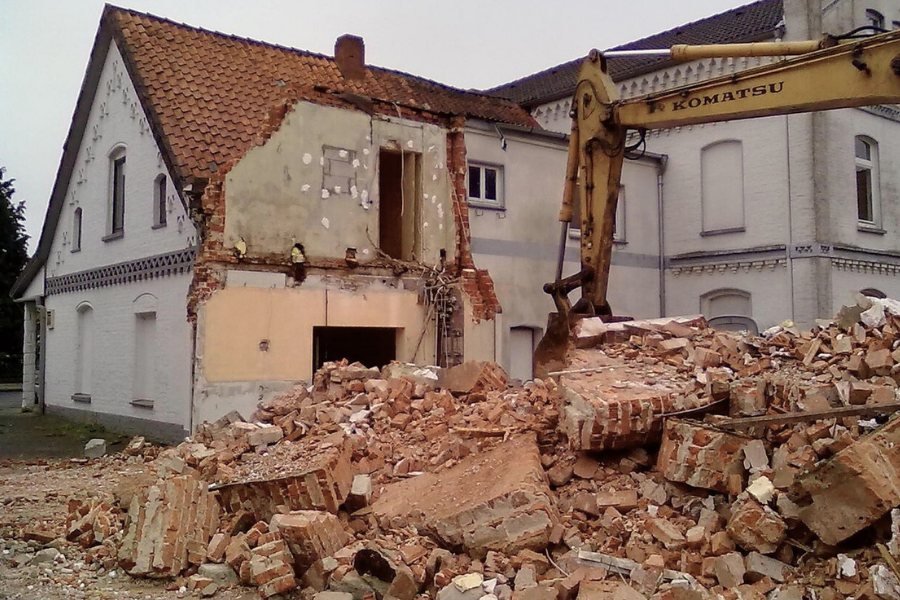
Why Expert Demolition & Renovation Matters in Kenya
In Kenya’s rapidly urbanising environment; from Nairobi’s dense residential estates to Mombasa’s aging colonial structures, the need for safe, methodical demolition and renovation work has never been more critical. Poorly executed demolition is a leading cause of structural collapse, worker fatalities, and costly neighbourhood damage.
At Structrum Construction Limited, we distinguish clearly between Renovation and Demolition. Renovation is the systematic improvement, refurbishment, or alteration of an existing structure to extend its lifespan or redefine its function. Demolition, conversely, is the controlled removal of all or part of a structure using engineering methodologies that prevent damage to adjacent properties, utilities, and persons.
Ignoring proper process leads to structural instability in surrounding buildings, accidental utility strikes (gas, water, electrical), environmental violations, legal liability, and project cost overruns. Our mission is to execute these critical first steps with surgical precision, protecting your investment and ensuring the foundation for whatever comes next is solid.
Our Comprehensive Renovation & Demolition Services
We deploy modern machinery, certified engineers, and strict safety protocols to deliver results on time and within budget.
Interior Strip-Out & Refurbishment
Complete removal of internal finishes, partitions, ceilings, and MEP services prior to renovations — preserving the structural shell.
Technologies Used:
✓Soft strip of non-load-bearing walls and partitions
✓Removal of finishes: tiles, screeds, plasterwork
✓ Safe disconnection and removal of M&E installations
✓ Controlled skip loading and waste disposal
Structural Demolition
Full or partial demolition of buildings using engineered sequence plans to protect neighbouring structures and utilities.
Our Approach:
✓ Pre-demolition structural survey and method statement
✓ Hydraulic excavator and hand demolition techniques
✓NCA-compliant site hoarding and exclusion zones
✓ Controlled implosion consultation for complex sites
Building Extension & Addition
Structurally sound additions — new floors, extensions, or annexes — integrated seamlessly with the existing structure.
Remedial Process:
✓ Structural load calculation and design review
✓ Foundation underpinning where required
✓ Beam and column insertion for open-plan conversion.
✓ Masonry, concrete, and steel frame additions
Asbestos & Hazardous Material Removal
Licensed removal and safe disposal of asbestos-containing materials (ACMs) common in Kenya's pre-1990 building stock.
Key Specifications:
✓ Asbestos survey and bulk sampling analysis.
✓ Negative pressure enclosure removal methodology.
✓ NEMA-compliant transport and disposal documentation
✓ Post-removal air quality monitoring certificate
Site Clearance & Preparation
Transforming a raw or previously developed site into a clean, compacted, and legally compliant platform ready for new construction.
✓ Vegetation, tree, and stump removal
✓ Existing slab and hard-standing breakout
✓ Underground services detection and capping.
✓ Mass excavation and level formation
1. Structural Demolition — Engineering the Takedown
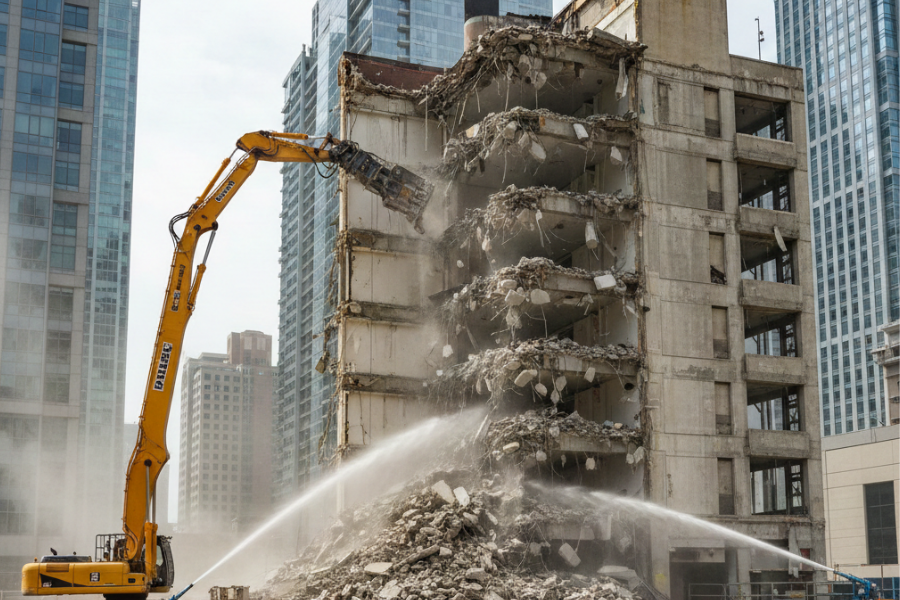
Demolition is far more complex than simply tearing down a structure. Without a methodically engineered sequence, the forces released during demolition can cause progressive collapse into neighbouring properties, undermine adjacent foundations, rupture underground utilities, and create catastrophic dust and debris hazards for surrounding communities.
Our Pre-Demolition Protocol
Before any physical work commences on a demolition project, Structrum’s engineers conduct a full Pre-Demolition Survey. This involves reviewing the original structural drawings, identifying all load-bearing elements, mapping all live utilities (water, gas, HV electrical, telecoms), and assessing the proximity and foundation type of adjacent structures.
A formal Method Statement and Risk Assessment is then prepared and submitted to the relevant county authority and NCA (National Construction Authority). This document specifies the exact sequence of demolition, the plant to be used, the waste management plan, and emergency procedures.
Demolition Methodologies
- Top-Down Demolition: Working floor by floor from roof to ground using hydraulic attachments. The safest method for structures in densely populated areas.
- Selective Demolition: Precise removal of specific structural elements (walls, slabs, beams) while retaining the surrounding structure — used during building conversions.
- Mechanical Demolition: High-reach excavators with hydraulic shears or pulverizers for efficient full-structure takedowns where space permits.
- Hand Demolition: Used where machinery cannot access — confined spaces, basement structures, or where precision adjacent to sensitive fabric is essential.
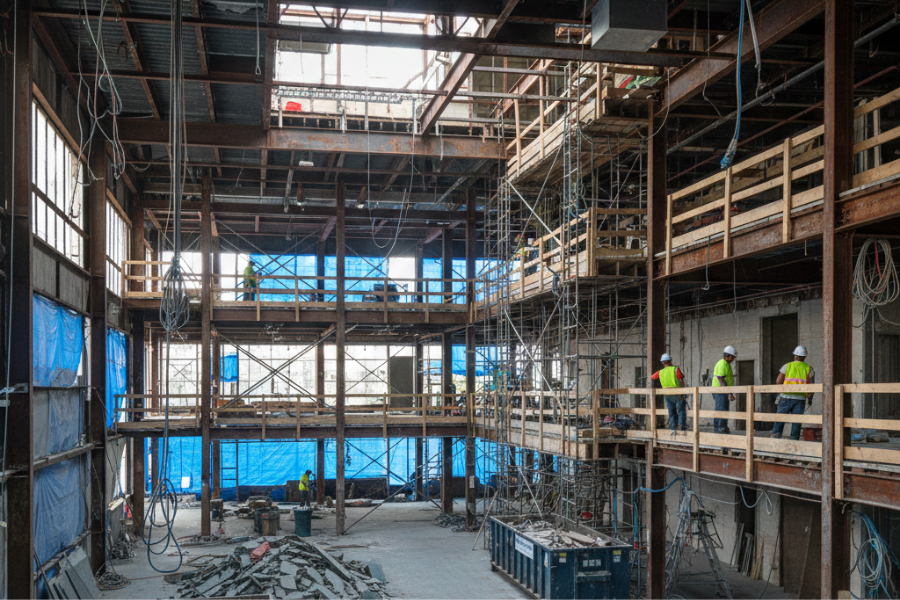
2. Interior Renovation — Systematic Transformation
Interior renovation projects require the careful coordination of multiple trades operating in sequence within a live or partially occupied environment. A failed sequence; for instance, installing electrical conduit before plumbing is roughed in, causes expensive rework and delays.
The Structrum Renovation Sequence
- Strip-Out: Systematic removal of all existing finishes, fixtures, and non-structural elements. Hazardous materials (asbestos tiles, lead paint) are identified and removed first under containment.
- Structural Works: Any new openings, beam insertions, or slab repairs are conducted. Load is temporarily propped while new structural members are installed and cured.
- Mechanical, Electrical & Plumbing (MEP) Roughing-in: New conduits, pipework, and ductwork are installed within walls and ceilings before any finishes are applied.
- Plasterwork & Screeds: Walls are re-plastered, floors are screeded level, and all MEP penetrations are sealed. Damp proofing membranes are laid under new floor screeds.
- Second Fix & Finishes: Tiling, joinery, painting, fixtures, and fittings are installed to the agreed specification. Snagging is conducted against a defined quality standard.
3. Façade Renovation & Concrete Repair
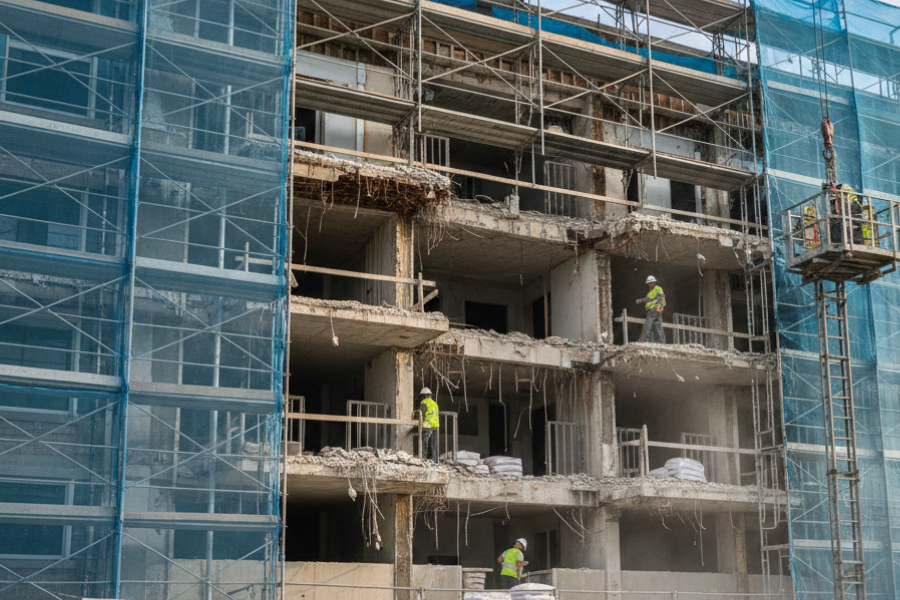
Kenya’s aging building stock — particularly residential and commercial buildings built in the 1970s through 1990s — is increasingly exhibiting concrete carbonation and chloride-induced corrosion of embedded steel. This manifests as spalling concrete, rust staining, and visible cracking — a structural liability if left unaddressed.
The Science of Concrete Repair
When steel reinforcement corrodes, its volume expands by up to 600%, generating internal stress that fractures the concrete cover. Simply patching the surface with standard cement is ineffective — the patch will debond within 12-18 months as the corrosion beneath continues to expand.
Our Structural Repair Methodology
- Mapping and Investigation: Covermeter survey to locate all steel. Carbonation depth testing with phenolphthalein indicator. Chloride ion testing on core samples.
- Break-Out: All delaminated and carbonated concrete is removed using chisels or scabblers to a minimum of 25mm behind the steel reinforcement bar. Corners are saw-cut square to prevent feathered edges.
- Steel Preparation: Corroded reinforcement is wire-brushed to SA 2.5 standard and treated with a passivating zinc-rich primer (Sika Monotop or equivalent).
- Reinstatement: Pre-dampened void is filled with a polymer-modified repair mortar (such as Sika MonoTop 412N) in layers, compacted firmly and finished flush.
- Protective Coating: A carbonation-resistant, elastomeric anti-carbonation coating is applied across the entire façade to re-alkalise and protect the concrete for 15+ years.
Our Technical Methodology
Precision at every step ensures longevity.
1. Site Survey
Structural assessment, utility mapping, hazardous material testing.
2. Planning
Method statement, NCA submission, programme of works.
3. Preparation
Site hoarding, propping, service isolation, safety briefing.
4. Execution
Engineered sequence demolition or renovation by certified crews.
5. Handover
Site clearance, waste certificates, structural sign-off.
Why Structrum Construction Limited?
Demolition and renovation are zero-margin-for-error disciplines. One miscalculation can collapse a neighbouring structure or injure a worker. Choosing the right partner is not a cost decision — it is a safety decision.
NCA Registered Contractor
Fully registered with Kenya's National Construction Authority. All works are compliant with the Physical Planning Act and local county by-laws.
Structural Engineering Oversight
Every demolition and major renovation is supervised by a licensed structural engineer who signs off the method statement and final structural certificate.
Full Insurance Cover
Contractor's All Risk (CAR) and Public Liability insurance indemnifies you against third-party damage and on-site incidents throughout the project.
NEMA Compliant Waste Disposal
All demolition waste is sorted, processed, and disposed of at NEMA-approved sites. We issue waste transfer documentation for your records.
NEMA Compliant Waste Disposal
All demolition waste is sorted, processed, and disposed of at NEMA-approved sites. We issue waste transfer documentation for your records.
NEMA Compliant Waste Disposal
All demolition waste is sorted, processed, and disposed of at NEMA-approved sites. We issue waste transfer documentation for your records.
Customer Reviews

Emily Waithera
My three bedroom mansion in Kirinyaga was completed by Structrum Construction Limited in the shortest time and with the professionalism that is worth mentioning.

Fredrick Kimutai
We consulted Structrum for a structural assessment before adding a second story, and their engineering team provided a clear, robust design solution. Their expertise instilled confidence, and the construction phase based on their plans went perfectly.

Elizabeth Wairumu
Structrum managed our full basement remodel, expertly coordinating the critical structural beam installation, intricate new plumbing runs, and flawless masonry work for the new fireplace. The quality across all trades was consistently high, resulting in a perfectly integrated and durable finished space.

Calvin Owino
Structrum's plumbing team resolved a persistent leak under our sink efficiently and professionally. Their diagnosis was spot-on, and the repair has been completely reliable ever since
Frequently Asked Questions
Do I need NCA approval before demolishing a building?
Yes. Under Kenya's Physical Planning Act and the NCA Act, demolition of any permanent structure requires a demolition permit from the relevant county government authority, and the contractor must be NCA-registered. Structrum handles the full permit application process on your behalf as part of our service.
How long does a typical demolition project take?
Duration depends on the size, structure type, and access constraints. A single-storey residential demolition typically takes 3–7 days. A multi-storey commercial structure may take 4–8 weeks using a top-down approach. We provide a detailed programme of works at the quotation stage.
Can you demolish part of a building while I continue to occupy the rest?
Yes, this is called selective demolition. We install temporary propping systems and site hoardings to isolate the demolition zone from the occupied areas. Our engineers produce a temporary works design to ensure the retained structure is fully supported throughout. This is common in phased refurbishments.
How do you deal with the demolition waste?
We sort all demolition arisings on-site into categories: concrete/masonry (crushed and recycled as fill), metal (sold to scrap merchants), timber (chipped for biomass), and general waste (disposed of at NEMA-approved sites). We issue you with Waste Transfer Notes for your compliance records. Our landfill diversion rate typically exceeds 85%.
My building has asbestos roof sheets. Can you remove them safely?
Yes. Asbestos Cement (AC) sheets were widely used in Kenya before the 1990s. Provided they are in non-friable (intact, bonded) condition, they can be carefully removed and double-bagged for licensed disposal. We conduct a pre-removal survey to determine the type and condition of the ACMs before proceeding.
What is the difference between renovation and refurbishment?
Renovation typically involves restoring something to a good state of repair and may include structural changes or improvements to layout and function. Refurbishment is generally a cosmetic or finish upgrade (new paint, tiles, fixtures) without changing the structure. Both are services we offer, from full design-and-build renovation to cosmetic refurbishment programmes.